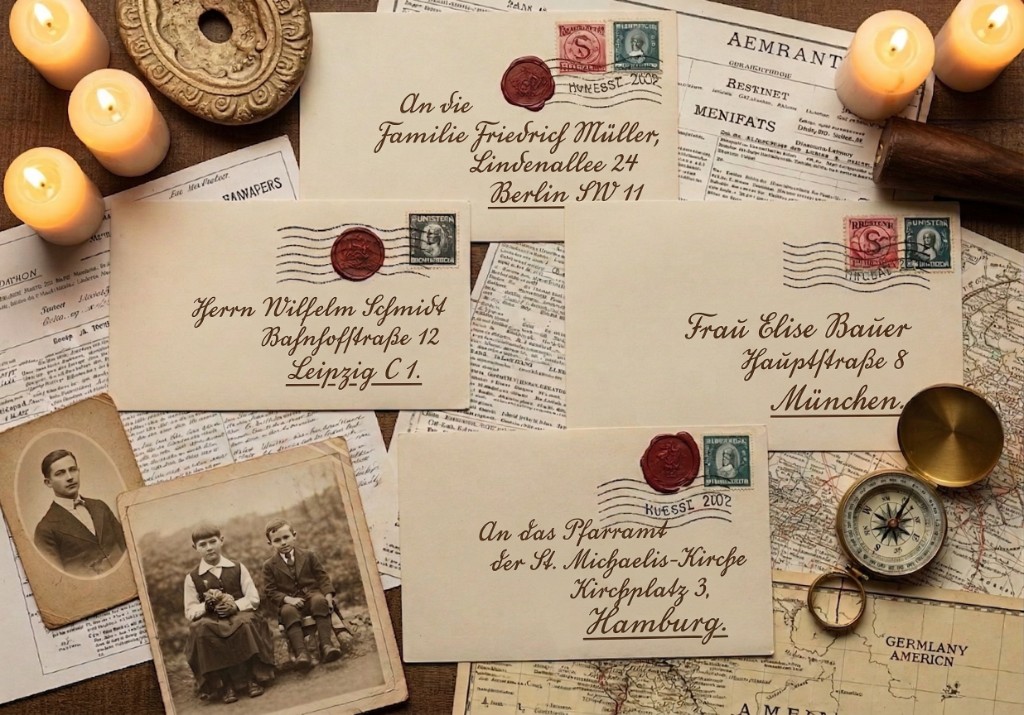
Old Handwriting, Deciphered
From an 1850s deed to a 1940s war letter — upload a photo and get clear, readable text. Built for the scripts, spellings, and abbreviations of earlier centuries.
Drop a photo of your page here
or click to select — free & no sign-up required
Every Era Wrote Differently
Handwriting is a fashion, and it changed every few decades. The 1800s gave America ornate Spencerian and copperplate hands; the early 1900s standardized on the brisk Palmer Method; earlier records use colonial-era hands with letterforms that have simply vanished — the long s that looks like an f, superscript abbreviations, thorn characters. German immigrant papers add Kurrent and Sütterlin to the mix. Our AI was built on exactly this material, so it recognizes old letterforms instead of forcing them into modern shapes.
Documents That Reward the Effort
Old handwriting guards real information. A deed or will fixes property lines and family relationships. A church register entry names godparents — often relatives — and home villages. A diary records what the weather, the prices, and the neighbors were actually like. Genealogists, title researchers, local historians, and families settling estates all hit the same wall: the record exists, but nobody can read it. A clean transcription turns that wall into a door.
When a Page Defeats Everyone: Experts
Some historical pages are beyond any software — water-stained registers, crossed letters written twice over the same paper to save postage, court hands full of legal abbreviations. For those we offer real human paleography expertise: the Expert tier (from $14.90/page) delivers a full manual transcription, with scholarly-diplomatic standards available on request and personal consultation on your document before you commit.
What you'll find — and what our AI can read
- 19th-century American cursive — Spencerian, copperplate
- Colonial & early-American hands — deeds, wills, registers
- 20th-century Palmer Method letters and diaries
- German Kurrent, Sütterlin & Fraktur
From handwriting to clear text
Frequently asked questions
How do I read handwriting from the 1800s?
Upload a photo of the document — the AI was trained on historical letterforms (Spencerian, copperplate, early-American hands) and returns clear, typed text in minutes. A side-by-side magnifier lets you verify names, dates, and places against the original.
What is the old-fashioned writing on my deed or will called?
Most 19th-century American documents use Spencerian or copperplate-style script; earlier records use colonial round hand or secretary hand. You don't need to identify it yourself — the AI adapts to the script automatically.
Can it read the long s and old abbreviations?
Yes. Archaic letterforms like the long s (ſ), superscript contractions (sᵈ, recᵈ), and old spellings are exactly what the AI was built for — they're transcribed faithfully instead of being forced into modern words.
Can it read German Kurrent or Sütterlin?
Yes — old German scripts are a core specialty. Kurrent, Sütterlin, and Fraktur documents are transcribed and can be translated into English automatically in the same step.
What if the page is too damaged?
The free analysis tells you honestly how much is recoverable. For water-stained, crossed, or extremely difficult documents, human specialists take over — full expert transcription from $14.90 per page, with a personal consultation first.
Related articles
How to Read Old Deeds and Wills: Deciphering Legal Handwriting from the 1700s–1800s
Old deeds, wills, and probate records hide family history behind archaic script and legal formulas. How to decode the handwriting, the abbreviations, and the boilerplate — step by step.
Read articleSpencerian to Palmer to D'Nealian: 150 Years of American Cursive (and How to Read Each)
Date any American document by its handwriting: Spencerian (1850–1900), Palmer Method (1900–1960s), D'Nealian and beyond. Identifying features and reading tips for each era.
Read articleHow to Read Old German Handwriting: Your First Steps to Decoding Ancestor Letters
Practical guide to reading old German handwriting (Kurrent & Suetterlin). Letter-by-letter decoding strategies, common word patterns, and when to use AI transcription for your family documents.
Read articleHow to Read Faded Handwriting: 7 Techniques That Actually Work
Faded ink, pencil ghosts, water stains: practical techniques to recover unreadable handwriting — lighting tricks, free photo filters, and when AI can read what your eyes can't.
Read article